This blog was republished from Instructional Design at Park University’s WordPress blog originally published June 26 2017.
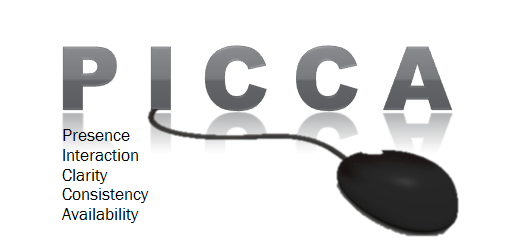
The PICCA Approach is a grew out of the data collected from student performance assessments in response to course evaluations. The PICCA Approach is the five must-do’s for faculty and students in their online course experiences of teaching and learning.
Gina Cicco, Associate Professor, Department of Counselor Education, School of Education, St. John’s University, developed The PICCA Approach “based on the foundation that an understanding of learning style preferences impact the outcomes in online courses, including student mastery of course objectives…The must-do’s, i.e. Presence, Interaction, Clarity, Consistency, and Availability, summarized in the acronym “PICCA.” According to Cicco, the online educator seeks to eliminate practices that do not enhance student learning, but also to continue to improve on those methods that have worked in the classroom. She asserts that the PICCA Approach can accomplishes these goals.
PRESENCE
In the PICCA Approach, designing for opportunities for student and instructor presence in the classroom is essential for success. According to Cicco,
Success for student starts with logging into the course more frequently and engaging with the course resources. The students who are present in the course are more likely to be aware of announcements and reminders that have been posted as well as see emails sent by the instructor or classmates.
Instructors that are present in the “virtual classroom will also be able to better identify the students who are struggling, missing assignments, or in need of more support and clarification. Providing a supportive faculty intervention early on in the semester may help students to avoid low grades and failures. It also gives students the impression, for example by contributing to required online discussions, that they are accessible, involved, professional, and trustworthy, which will ultimately improve faculty-student rapport ” (Cicco)
So how can we design more opportunities for student and instructor presences in the course?
One design idea is to include three types of required student discussion responses:
- Student responds to one of several discussion prompts.
- Student responds to other student’s discussion responses.
- Instructor (and/or student) responds to student responses and poses a question based on response.
- Students responds to one of the instructor (and/or student) questions.
This discussion scheme promotes instructor/student presence in the course to be extended to additional dialog and engagement with the course content.
INTERACTION
Going hand in hand with being present in the course is interacting within the course. According to Cicco
interacting with classmates and with faculty helps students to build relationships and stay current on trends, such as in discussion boards, current problems or challenges students are facing in particular assignments, and being aware of changes in the curriculum or requirements. Interacting does not simply mean posting an answer to a discussion question, but instead reading others posts’ and commenting on them while reading others’ comments to one’s own posts and replying to them as well.
Cicco goes on to assert that faculty have the responsibility to show students that they are “interested in their work, ideas, concerns, and progress…No student or faculty member should feel alone in a vibrant online course.”
ACHIEVING INTERACTION
According to Cicco, “The course design should include activities that require collaboration and teamwork, such as discussion boards, small-group projects, interviews, or field trips to a specific course-related site, to pave the way for real interaction to take place.”
CLARITY
The first “C” in PICCA stands for Clarity. Cicco suggests that clarity aid communication in online courses.
She suggest several areas where clarity is essential:
SYLLABUS
The syllabus should focus on clear and concise expectations. She suggest that “curricular objectives, required and suggested assignments, course materials
and resources, scoring rubrics, and calendars,” should be made available before the course begins.
CONCISE LANGUAGE
Cicco suggests that text-laden “announcements and emails may be particularly ineffective, because they may cause students to skim and miss important information in an effort to save time or avoid boredom.” She recommends that it using bullets and outlines may allow students to skim without missing important information.
PEER REVIEWED ASSIGNMENTS
Another ways to bring clarity to online courses is the have students peer review assignments. Cicco suggest that this might help produce higher quality work.
CONSISTENCY
According to Cicco, information communicated online is only clear if it is consistent. She suggests that changing messages within the course can cause confusion. For example, if an assignment is described one way within the course assignment page and another way in an announcement, the instructor ” risks being viewed as unprofessional, untrustworthy, or altogether incompetent, which may cause students to become frustrated or to not take the course seriously.”
In her article, How Five Web Design Principles Boost Student Learning in an Online Course, Debbie Morrison says that consistency which which she considers one of the five design principles in course design is probably one of the most underutilized principles. She suggests that how resources are ” titled, labeled and/or placed within the course site” can have a positive or detrimental effect on the student experience. She says, for example, that when an article is not consistently referred to in the course, students may spend valuable time searching, checking, and comparing materials to make sure they are accessing the correct content rather than studying and learning the material.
In the article from University of Western Georgia, consistency is the key to a positive student experience.
While UWG Online fully supports faculty’s desire for academic freedom, we also support our students’ freedom to learn in well designed environments…A standard navigation structure does not constrain what is taught or how; it just determines the course layout: where teaching materials and learning activities can be found.
References
Cicco, G. (2016). Reflecting On Online Course Evaluations: Five Must-do’s. i-mangaer’s Journal of School Educational Technology, 7.
 Mary Burkart Portfolio
After I originally commented I appear to have clicked on the -Notify me
when new comments are added- checkbox and from now on whenever a comment is added I get four emails with the exact same comment.
There has to be an easy method you are able to remove me from that service?
Thank you!